What a dead rooftop unit costs a business
A cooling failure in a home is an uncomfortable evening. In a business it is a different kind of problem. Customers walk out of a store that has gone stuffy, staff slow down or go home, and anything that cannot sit in the heat, such as food, medication, electronics or finished stock, starts a clock the moment the air stops moving.
That is why commercial cooling is judged by how fast it comes back, not only by how it runs when everything is fine. Johnson works for both residential and commercial clients, and keeps emergency service available after hours and on weekends for the calls that cannot wait for the next business day.
If a unit goes down while the building is open, call (864) 579-3247 and say plainly what the space holds and who is inside. That tells the office what to prioritise before a technician is on the road.
Inside a packaged rooftop unit
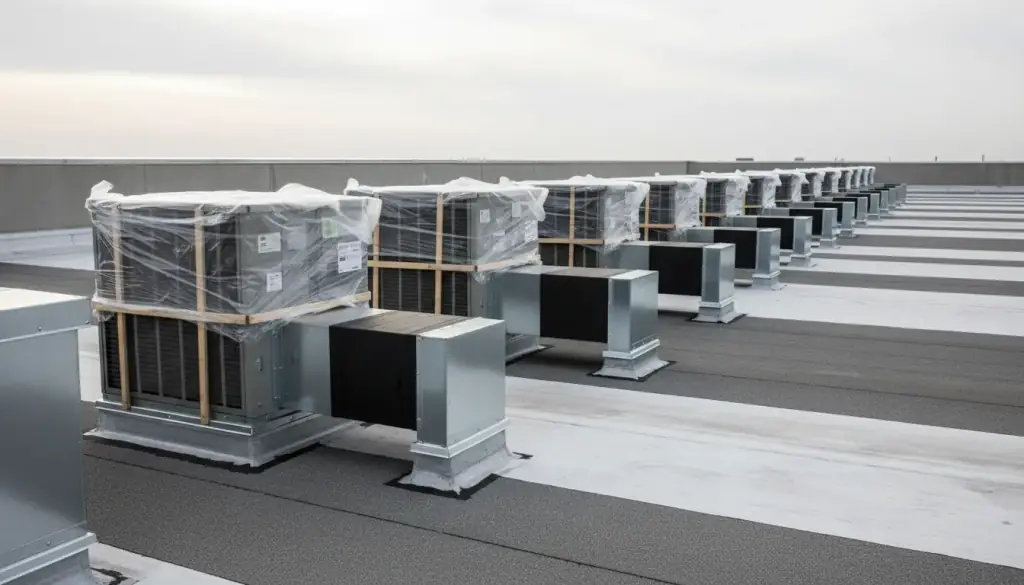
Most small commercial buildings cool with packaged units on the roof, where the compressor, condenser coil, evaporator coil, blower and controls all sit in one cabinet. That layout makes service accessible, but the roof is also where weather, debris and vibration do their slow damage.
The usual work is specific. Belts on belt-driven blowers wear, stretch and slip. Filters load up and starve the coil of air. Condenser and evaporator coils collect grease, pollen and dust that insulate them. Economizers, the dampers that bring in outside air when it is cool enough, jam or lose their sensor and either stay shut or stay open. Controls and contactors fail from heat cycling. And the curb and duct connections, where the unit meets the building, are the seams where conditioned air leaks away before it reaches a room.
Johnson installs, repairs and maintains these systems on all brands, so the first question is what is on your roof, not what we would prefer it to be.
Maintenance programs, and planning the replacement before it plans you
A maintenance program turns the breakdowns that arrive at the worst moment into scheduled visits at a quiet one. Belts, filters, coils and electrical connections get looked at on a routine, and the notes from each visit build a record of which unit is aging and which one is not.
That record is what makes replacement planning possible. A unit that has needed repeated work, or that is reaching the end of its life, can be budgeted for and installed on your schedule rather than on a Saturday in the middle of a heat spell. Johnson gives free quotes on new systems, and financing is available.
The Spartanburg, SC office answers Monday to Friday, 8:00 AM to 6:00 PM. Ask for a quote on a replacement or a walk-through of what a maintenance program would cover for your building.